Monday, November 5, 2007

Crunch

From Wikipedia, the free encyclopedia


• Ten things you may not know about images on Wikipedia •
Jump to: navigation, search
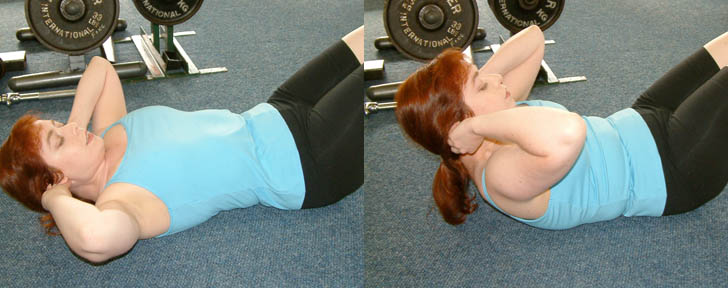
Performing the crunch.

The crunch, also known as curl-up, is one of the most common exercises for the abdominal muscles, primarily the rectus abdominis. It is considered a safer alternative to the sit-up[citation needed].

Form

Proper starting form is lying face up on the floor with knees bent. The movement begins by curling the shoulders towards the pelvis, with hands placed behind or beside the neck, or crossed over the chest. Using the hands to exert force on the neck can cause injury, so common practice is to avoid placing the hands behind the head itself. The hands can however, form a shelf to support the weight of the head, so that the neck flexor muscles can relax during the movement. So long as the neck remains in an extended position with the neck flexors relaxed, then the hands are not exerting excessive force and it will not cause injury.

Alternatives

Crunch exercises may be performed on swiss balls. Weights may be used, typically held under the chin, to increase resistance. Holding a medicine ball behind the head exercises the lats, and if the elbow is extended so that the forearm is no longer vertical, the triceps, as supporting muscles. Increasing the distance will also increase the load on the abdominals due to leverege. [citation needed]

Differences between a crunch and a sit-up

Unlike the sit-up, when performing a crunch the lower back should not leave the floor. This is said to eliminate any involvement by the hip flexors, and make the crunch an effective isolation exercise for the abdominals. The difficulty of the crunch can be increased by lying on a decline bench and/or holding a weight on the chest or behind the head.

Types of crunches

Variants include:

* The reverse crunch or dragon flag (popularized by Bruce Lee and also Sylvester Stallone in his movie Rocky). Beginning laying horizontal on a bench, the arms are used to hold the underside of the bench to anchor the shoulders to it to prevent rolling forward. The rest of the body inferior to the scapulae is then pulled from the bench. Beginning with legs flexed, the legs can be extended slowly to increase the difficulty of the movement (and tension on the core muscles) due moving the weight further from the levers. Throughout the movement the legs and hips are meant to remain locked while movement occurs in the abdominal region.
* The twisting crunch is performed by lifting one shoulder at a time. More emphasis is placed on the obliques.
* The Thai Crunch is performed by hitting the stomach after full contraction. This variation is used by Muay Thai fighters to condition the core to take hits from punches or knees.
* The cable crunch is performed while kneeling upright by curling the body to pull down on a cable machine. The hips are kept motionless, so the bodyweight does not assist the movement.
* The bicycle crunch is performed by bringing together alternating elbows and knees, resulting in a leg motion similar to pedaling a bicycle.

Friday, October 26, 2007

Deadlift


Deadlift
From Wikipedia, the free encyclopedia


The Deadlift is a weight training exercise where one lifts a loaded barbell (or, in the case of the trapbar deadlift, a loaded trapbar) off the ground from a stabilized bent-over position. It is one of the three gauges of powerlifting, and is an excellent exercise for overall body development if done properly.
Contents


* 1 Overview
* 2 World Records
* 3 Muscles involved
* 4 Variations
* 5 Dangers
* 6 References
* 7 External links

Overview

The deadlift is a compound movement that works all of the major and most of the minor muscles in the abdomen and lower body, with emphasis on the Erector spinae, lower back and back, along with the quadriceps, hamstrings, and gluteus maximus. The remaining muscles are involved in stability control. It is, in a sense, the purest single event test of strength because it is one of the few lifts of dead weight (weight lying on the ground). In most other lifts the weight changes direction or starts in the air and several other athletic skills such as balance, coordination are emphasized. For example, both Olympic weightlifting events require a great deal of athletic skill in addition to strength. In addition, it is commonly believed to be the oldest test of strength dating back to cultures who competed at lifting the heaviest stones.

World Records

The IPF (International Powerlifting Federation) the current world record is 408 Kg. The all time record is held by Andy Bolton (UK) using a single ply deadlift suit and no straps, with a lift of 455.0 Kg (1003.27 Lbs). Deadlift suits are the least supportive item of powerlifting equipment, even less so when the lifter uses a regular grip outside of the legs, that is why this lift is accepted as being the greatest test of strength.

The Raw World record is unknown.

Note: As for all powerlifting federations, records have a large range, as different federations / organisations have different rules on what is worn, and the lift performance.

Muscles involved

* Torso
o Front
+ Abdomen
# Rectus abdominis (under aponeurosis)
+ Obliques
# Abdominal external oblique muscle
o Back
+ Iliocostalis
+ Intertransversarii laterales lumborum
+ Latissimus dorsi
+ Levator scapulae
+ Longissimus
+ Quadratus lumborum
+ Rhomboideus major
+ Serratus posterior superior
+ Serratus posterior inferior
+ Splenius cervicis
+ Teres Major
+ Trapezius muscle
* Legs
o Quadriceps
+ Rectus femoris
+ Vastus lateralis
+ Vastus intermedius
+ Vastus medialis
o Hamstrings
+ Biceps femoris muscle, long head
+ Biceps femoris muscle, short head
+ Semitendinosus
+ Semimembranosus
* Hips
o Gluteal muscles
+ Gluteus maximus
+ Gluteus minimus
o Piriformis
o Superior gemellus
* Forearms
o Flexor digitorum profundus

Variations

The Romanian deadlift is commonly used by Olympic Weightlifters. This variation puts more emphasis on the hamstrings & glutes. To perform them, unlock the knees & let the weight descend until knee level by bending from the hips.

The Sumo deadlift is a variation of the deadlift whereby the legs are spread far apart to the sides, mimicking a sumo stance, hence the name. This variation changes the emphasis of the lift to the legs instead of the back. The sumo deadlift is purported to be easier for those with large waists, and if done incorrectly, is capable of placing excessive stress on the hips and hamstrings, as well as the connective tissues of the pelvic bone and by extension, the lower back.

Deadlifts can be performed using dumbells or barbells, with one hand or two hands & with one leg or two legs. Variations are only limited by the athlete's imagination. Other variations are the Side deadlift or Suitcase deadlift, Deadlift from a box, Rack Pulls, Deadlift lockouts, and "Kuck Pulls"

The archaic "dead weight lift", or "dead weight lift with lifting bar" involved a T-bar with weight loaded on it while the lifter stood on sturdy chairs or other such platforms. An unbelievable amount of weight could be lifted in this manner due to its short range of motion; the main limitations are in the grip. This lift is similar to the modern day rack pulls, where a heavy amount of weight is lifted deadlift style a short distance in a power cage or squat rack.

There are two grips to use. Both overhand and a mixed overhand-underhand (sometimes called "offset," "staggered," "alternating", or "mixed") grip. Considering forearm strength, overhand grip still suffer from the bar potentially rolling about, which the mixed grip is capable of neutralizing, through the physics of reverse torsion. The mixed grip also allows more weight to be used for this reason.

In order to prevent the bar from rolling out of the hands, some lifters have been known to use an Olympic lifting technique known as the "hook" grip. This is similar to an overhand grip, but the thumbs are inside, allowing the lifter to "hook" onto them with the fingers. The hook grip can make it easier to hold heavier weights using less grip strength, and keeps both shoulders and elbows in a symmetrical position. While it theoretically takes much of the stress off of the joints which might be created by the twisting of a mixed grip it has the disadvantage of being extremely uncomfortable for the thumbs, something which those who advocate it says will pass once a lifter becomes accustomed to it. Another, but rarely used method is a combination of the mixed overhand-underhand grip and the hook grip, preferred by people who lift heavier weights than their grip can handle, but who don't want to rely on lifting straps or other supportive gear.

The trapbar deadlift is a variation of the deadlift using a special U-shaped bar (a trapbar). This allows more clearance for the knees to pass "through" the bar.

Dangers


Improper form can precipitate new conditions, aggravate existing ones, and possibly cause injury, especially the heavier the weight one lifts. Failure to keep the back straight during the movement causes undue stress to the spinal discs, by pinching the front and leaving a gap at the back, forcing the internal fluids to compress towards the back, and potentially causing at least one herniated disc. This is especially true of the lumbar region of the spine, which is designed to bear the bulk of the compressive forces on the upper body.

In addition, the compression can squeeze the spinal roots of the spinal cord, causing nerve-conditions like lumbago or sciatica.

A good method to avoid lower back injuries is to keep the abs braced using the Valsalva maneuver. This will build anterior support for the spine.

Some weightlifters use special belts to keep their lower back stabilized. Whether or not these belts actually prevent injuries is debated. Furthermore, one school of thought suggests that the use of belts should be minimized, as it does not allow for the development of one's stabiliser muscles, thereby increasing the potential of serious injury.

Using an underhand grip is potentially hazardous on heavy deadlifts as a supinated grip shortens the biceps muscle and increases the load on it, possibly leading to a rupture of the muscle or connecting tendons. The risk is most notable in individuals without full flexibility in the elbow joint.

From : www.wiki.com
Monday, October 22, 2007

Chin up


A chin-up has a specific form. The movement begins with the arms extended above the head, gripping a fixed chin-up bar (or bar attached to a pulley in the case of the similar pulldown exercise, with the palms facing away from the exerciser) with a supinated grip (palms facing the exerciser). The body is pulled up, or weight pulled down, until the bar approaches or touches the upper chest. The weight is lowered until the arms are straight, and the exercise is generally repeated.

Chin-ups can be performed with a kip, where the legs and back impart momentum to aid the exercise, or from a dead hang, where the body is kept still. Performing the chin-up correctly can be tricky because of the natural tendency to do most of the work with the biceps rather than the lats. Initiating the pull with the shoulder blades helps avoid this problem. The exercise is most effective when the body is lowered down to a full extension.

Chin-ups are often incorrectly referred to as pull-ups. The term pull-up is traditionally used when the exercise is performed with a pronated grip.

[edit] Muscles targeted

Chin-ups target the latissimus dorsi muscle, assisted by the brachialis, brachioradialis, biceps brachii , teres major, posterior deltoid, infraspinatus, teres minor, rhomboids, levator scapulae, middle and lower trapezius and pectoralis minor muscles. Chin-ups are thought to build the width and thickness to one's back, as well as promoting growth of the biceps, brachialis, brachioradialis and pronator teres.

[edit] Variations
A weight belt can be used to add weight to a chin up

* Sternal chinups — this variant employs an extended range of motion, raising the sternum to the bar.
* Towel chin-ups — a towel is looped over the bar, and instead of the bar, the towel is gripped.
* Weighted chin-ups — weight is added with a dipping belt or weight belt.
* One handed chin-ups — one hand grips the bar and the other hand holds the wrist or forearm of the gripping arm.
* One arm chin-ups — one hand grips the bar; the other hand hangs free and does not assist with the pull.
* Drop chin-ups — the grip is released at the top of the movement, and the bar caught towards the bottom of the movement, to incorporate a slight drop. This variant is for advanced athletes only.
* Supine chin-ups — in the supine position (with the feet initially supported), the arms are held perpendicular to the body as the grip the bar; the chest is pulled towards the bar instead of the chin. This exercise is performed in the horizontal (transverse) plane, whereas other chin-up variations are performed in the vertical (coronal) plane. As a result, this variation recruits the trapezius and teres major muscles much more than a vertical chin-up would and is often considered a type of row.

Beginners who are not strong enough to perform a chin-up may make use of an assisted chin-up machine, where one stands on a bar with a counterweight to reduce the weight that one pulls up. Another useful exercise for beginners is the negative chin-up, where one is assisted to the top position and executes a slow, controlled descent. These machines frequently also include a dip bar, allowing for assisted dipping.

from
Content : www.wikipedia.com
Picture : www.building-muscle101.com/wide-grip-chin-up.html

Wednesday, August 29, 2007

Squat

The squat is a lower body exercise used in strength training. It is also a competitive lift in powerlifting and an essential movement in the sport of weightlifting. The exercise's main emphasis is on the quadriceps and the glutes, but it also involves the hamstrings, the calves, and the lower back. The squat is often called "the King of exercises" by those who believe it capable of inducing more and faster muscle growth than any other exercise.

Movement
The squat is performed by bending the legs at the knees and hips, lowering the torso between the legs, and then reversing direction to stand up straight again. The torso remains relatively upright throughout the movement. It acts as a supporting structure, unlike its role in the deadlift. Proper technique is critical, otherwise serious injuries or gradual injury over a period of time can occur. The back must maintain its natural curvature and not "round out" (excessive lumbar or thoracic kyphosis), otherwise excess strain can be placed on the spine and cause serious injury. Lifting belts can be used to help support the lower back.

Saturday, August 11, 2007

After losing 180 kg

This is almost ridiculous. He must be very determined to lose this dramatically 180kg. I wonder how long he took to lose that much of weight. After he lose 180kg, he had to go through certain surgery to overcome his loose skin problem.


Monday, August 6, 2007

I like to Excercise with Lat Pull Down For My Back

Back Introduction

It's hard to say which of your back muscles is the most important. They're all necessary for certain functions and motions. The topmost muscles allow you to move your neck, and they work in concert with your shoulder muscles to help you lift. Mid-back muscles like the erector spinae allow you to bend over and stand back up.

Lower-back muscles, like the quadratus, work together with the oblique abdominal muscles, helping to support your spine and giving you greater range of movement. If anyone of these muscle areas is weaker than the others, it can lead to serious back pain and leave you open to a muscle pull or worse.


Wide Pull downs To The Front

This exercise widens the upper lats. It allows you to do Chins with less than your total body weight, so you can do a lot of extra reps for the upper back if you feel you need more work in that area (it shouldn't replace chins though, they are just too great a tool).

EXECUTION: (A) Grab a long bar with a wide overhand grip and sit on the seat with your knees placed under the support.

(B) Pull the bar down under control until it touches the top of your chest. Make sure that the upper back does the work and your not swaying back to involve your lower back. Then let the weight go back up, extend the arms again, and really feel your lats get a full stretch. Deviation: Try doing Lat Pull downs behind the neck instead of in front, it's a totally different feeling.

Friday, August 3, 2007

More and More


Today I lift more weight.
I feel that good...
Muscle gains,I can do it the dense way, as in density training a great way to trick my muscles into lifting more weight for more reps.
In short, this advanced training protocol will multiply the overall volume of work I complete during a session

Thursday, August 2, 2007

Life goes on!

Today I'm still fitness. I'm done for program today.


I post this picture for my friends.


Wednesday, August 1, 2007

First Day of August

My old friend come back to workout.
But he's not good to day.He's very tried over to finish the work out set.

Tuesday, July 31, 2007

Work Out Table of August

Monday, July 30, 2007

Look at this guy 2!!!


Look at this guy!!!


4 Years of Persistent Trainning

Oh! my God...

I can't believe it... 4 years of trainning

Good job Man

Sunday, July 29, 2007

Trick of Squat Jump


Begin by flexing downward to a half-squat position; immediately check this downward movement and explode upward as high as possible, extending the hips, knees, and ankles to maximize length as quickly as you can. Initially, freeze the landing, check for quality; then you can reset and begin another repetition. Progress from the single response to the multiple with a pause sequence of repetitions, then finally to multiple responses, initiating the jumping phase just before reaching the semisquat position. Work for maximum height for each jump

Thursday, July 26, 2007

Time is so fast

Today

I excercise with

1.Warm up (Jump - 300 Times)

2.Stand Calf Rise (100)

3. Squat (50)

4.Barbell Curl (50)

5.Chin Up (30)

6.Back (30)

7.Sit-up (50)

Time is so fast , But I can do it.

Wednesday, July 25, 2007

Tips of The Day : Successful of Mind

Today I begin fitness at 06:00 PM
and I can finish at 06:45 PM

That's good That's Goood boy...